

































Disclosure: This article contains no paid links or sponsored mentions. If we add affiliate links later, we’ll mark them clearly. Planting dates vary by location, so use our ZIP frost calendar for yours.
Knowing when to start seeds indoors is the difference between sturdy transplants and leggy seedlings that outgrow their pots weeks too soon. The good news is that the method is simple. You need one date, a seed packet and a calendar, and you can plan a whole spring of planting in about ten minutes.
That one date is your average last spring frost. Every timing note on a seed packet, like “start six to eight weeks before last frost,” counts back from it. Once you know yours, you can line up each crop, fill your trays in the right order and have plants ready just as the garden warms up.
Starting seeds indoors also opens up far more choices than the garden center shelf. Seed catalogs carry many more varieties than you’ll find as started plants, and a packet of seed is a low-cost way to grow many plants. A little planning in late winter pays off all summer long.
Find your last frost date first
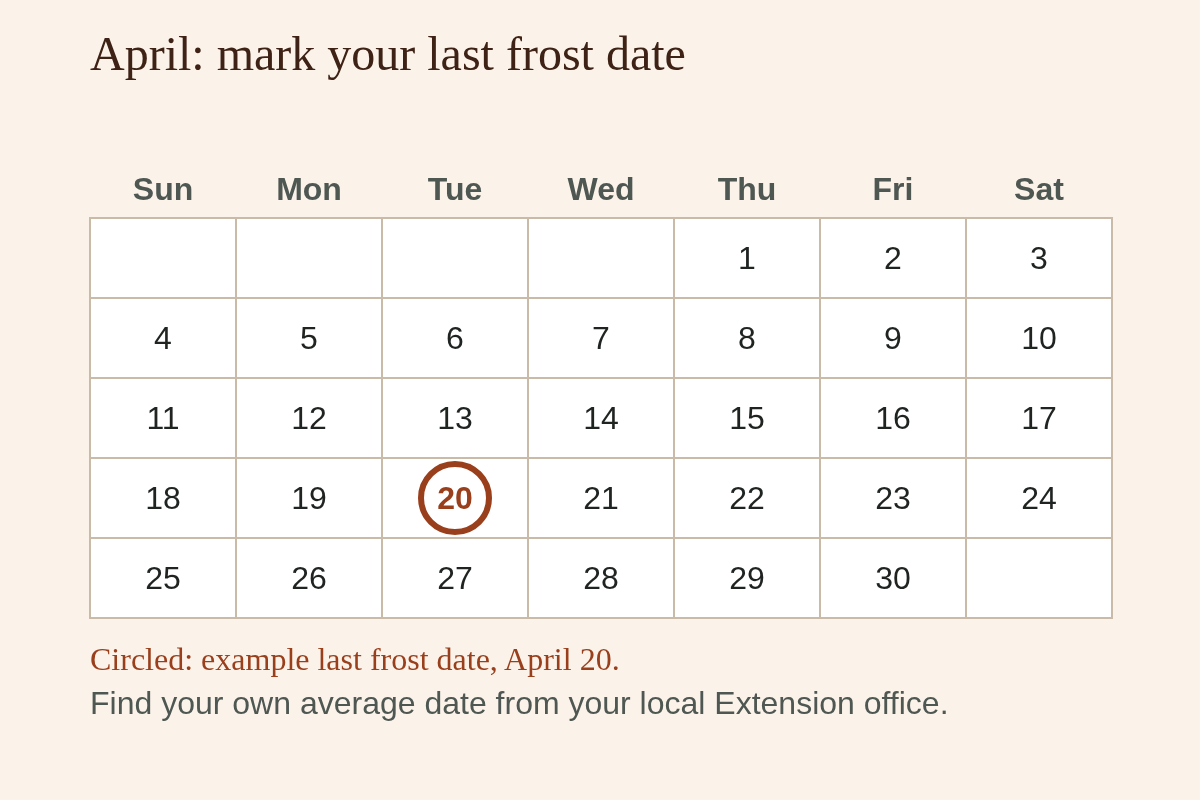
Your last frost date is the anchor for deciding when to start seeds indoors. It’s the average date of the last light freeze in spring, and it varies widely from place to place, even within a short drive. Enter your ZIP code in our ZIP frost calendar to get yours before you open a single packet.
Remember that the date is an average, not a promise. Some years a late cold snap arrives after it, and some years spring comes early. That’s why tender crops like tomatoes and peppers usually go outside a little after the date, once the danger of frost has passed and the soil has warmed.
If you live where winters are colder, your date falls later in spring and your indoor season starts later too. Where winters are milder, the date comes earlier and so does your sowing. The method is the same everywhere, which is why one plan works for every reader.
When to start seeds indoors: count back from the date
Seed packets give indoor timing in weeks before your last frost. To use it, mark your frost date on a calendar, count back the number of weeks on the packet, and write the crop name on that week. Repeat for each crop, and you have your own planting plan.
For example, if a packet says to start six weeks before last frost and your date falls in mid-May, you’d sow in early April. If your date falls in late March, you’d sow in mid-February. The same packet gives two very different sowing days, which is why a single national date never works.
Count forward too. Most seedlings need a week or two of hardening off outdoors before they go into the ground, and that time comes out of the window between sowing and planting. Build it into your plan so you’re not rushing plants outside on the first warm afternoon.
Which crops to start first
Crops fall into rough groups by how long they need indoors. The weeks below are general ranges for time spent inside before planting out, and your seed packet is always the final word. Varieties differ, so read the back of every packet before you sow.
The earliest starts are onions, leeks and celery. These grow slowly. Onions and leeks often need around fourteen to fifteen weeks indoors, and celery around twelve to thirteen. Onions and leeks are one of the few crops you can sow thickly in a single tray, since their small seedlings move to the garden easily.
The middle group includes peppers and eggplant, which often need about nine weeks inside. Both like warmth to sprout, so they benefit most from a heat mat. Broccoli, cabbage and cauliflower start a little earlier, around ten to eleven weeks before frost, though they handle cool weather and can go out earlier than tomatoes.
Tomatoes come later than many people expect. Many growers start them about five to six weeks before planting outside. Starting much earlier rarely gives you an earlier harvest. Instead, you end up with tall, crowded plants that are hard to manage indoors and slow to settle into the garden.
Some crops are better sown straight into the garden. Beans, peas, carrots, radishes, corn and most squash usually grow best when you plant the seed outdoors at the right time. Cucumbers and squash dislike having their roots disturbed, so if you do start them inside, use pots that break down in the soil.
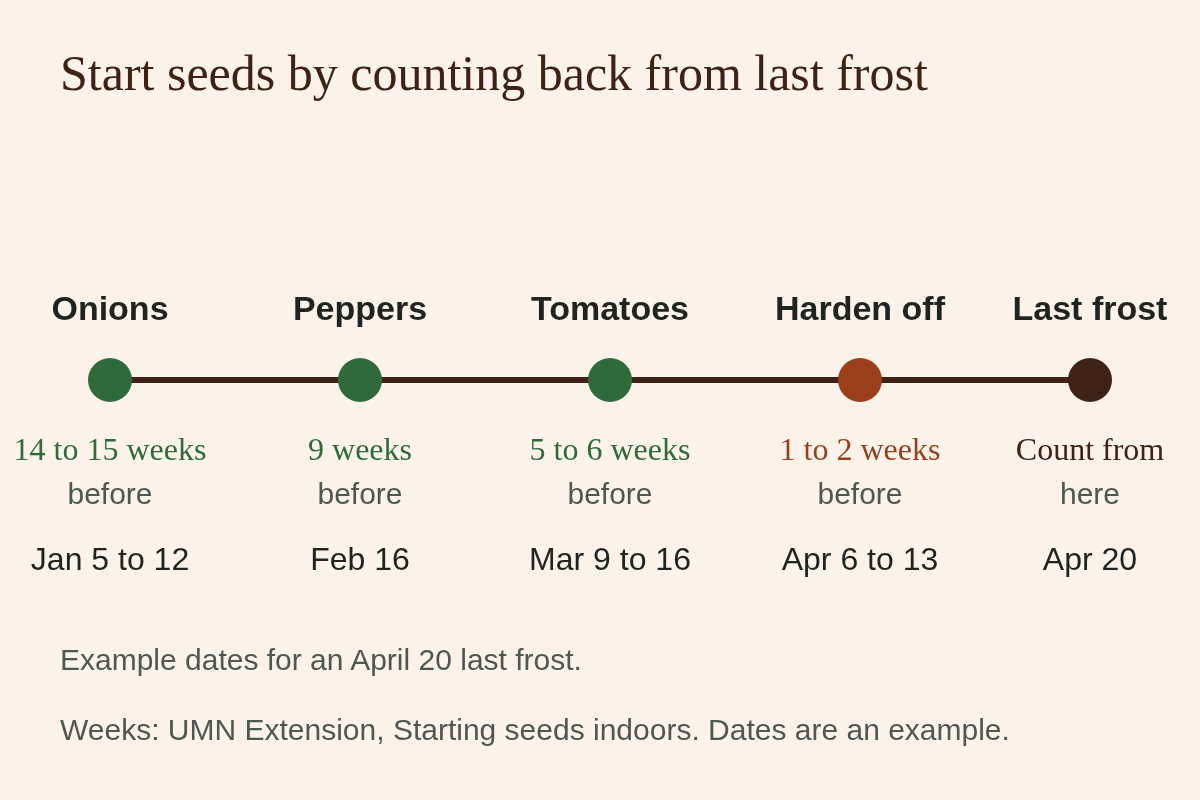
A simple seed starting schedule
A seed starting schedule turns those groups into a week-by-week plan. Count each week back from your own last frost date, so “week 10” means ten weeks before it. Adjust the crops to match what you like to eat, and check each packet against the plan.
Weeks 15 to 12 before frost: sow onions and leeks first, then celery from about week 13. This is also a good time to gather supplies, test your light and timer, and make sure last year’s seed still sprouts. Store leftover seed in an airtight container in the refrigerator so it stays viable longer.
Weeks 11 to 9: sow peppers and eggplant on a heat mat, along with broccoli, cabbage and cauliflower. Keep the mix evenly moist and the lights close. When the first seedlings show true leaves, thin each cell to its strongest plant by snipping the extras at the soil line.
Weeks 6 to 5: sow tomatoes. Pot up earlier crops that have outgrown their cells into containers one to two inches wider. Start feeding seedlings that have several sets of true leaves with a weak liquid fertilizer, mixed at about a quarter of the label strength, once a week.
Weeks 2 to 0: harden off your plants. Set them outside in a sheltered, shady spot for a few hours, then give them a little more sun and time each day. Cool-season crops can go into the garden earlier, while tomatoes, peppers and eggplant wait until frost danger has passed.
What starting seeds indoors needs
Starting seeds indoors takes less gear than most people expect. A shelf near an outlet, a few trays and a light will cover most home gardens, so set it up before your first sowing week. Choose a spot away from drafts, pets and heavy traffic, where spilled water or mix won’t cause damage.
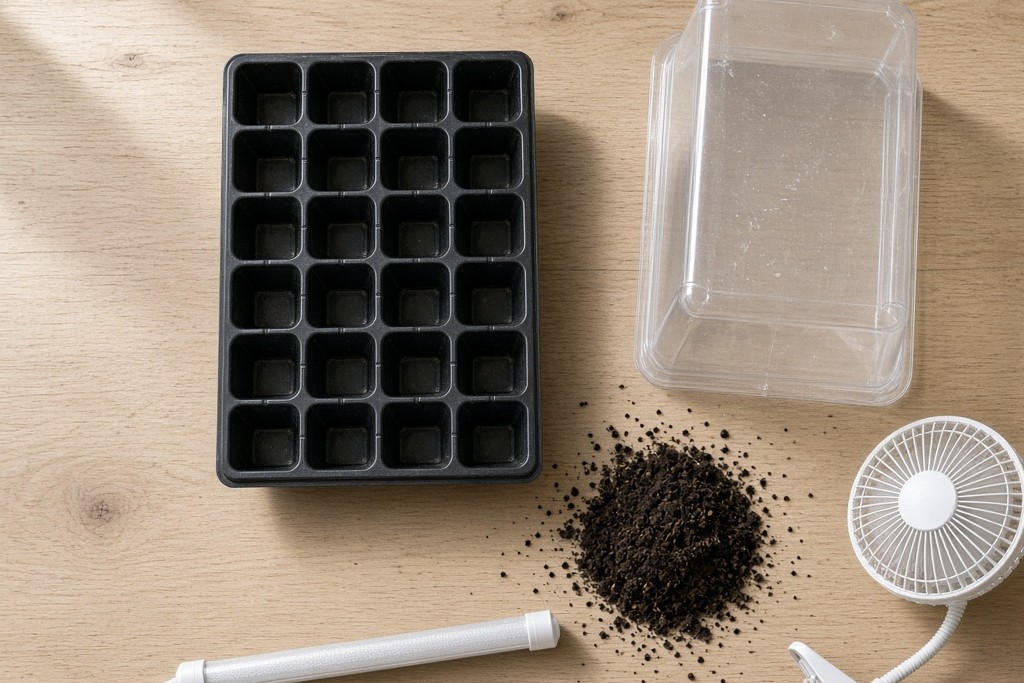
Containers and mix. Use small cells or pots with drainage holes, set in a tray to catch water. Fill them with a sterile seed-starting mix rather than garden soil. It’s light, free of weed seed and made to hold moisture while letting young roots breathe.
Light. A windowsill is often too cold at night, too hot by day and too dim to grow stocky plants. A fluorescent or light-emitting diode (LED) fixture works far better. Keep it about two to four inches above the seedlings, raise it as they grow, and run it twelve to sixteen hours a day on a timer.
Warmth. Keep the room above about 60°F. Potting mix can run several degrees cooler than the air, so a heat mat under the tray helps most seeds sprout faster and grow healthier roots. Don’t plug the mat into your light timer, since it should stay on through the night.
Water. Keep the mix moist but not soggy while seeds sprout. Mist the surface gently, or pour water into the tray and let the mix soak it up from below. Empty any water left standing in the tray afterward so roots don’t sit wet.
Sowing, potting up and planting out
Sow seeds at the depth on the packet. If you’re unsure, a good rule is to plant a seed about twice as deep as it is wide. Some seeds need light to sprout, so the packet may tell you to press them onto the surface or barely cover them.
Label every tray with the crop and the date. When seedlings outgrow the cells or tray they sprouted in, pot them up, moving each one into its own slightly bigger pot. Lift each seedling by its root ball or hold it gently by a leaf, never by the stem, since a crushed stem or broken growing tip may not recover.
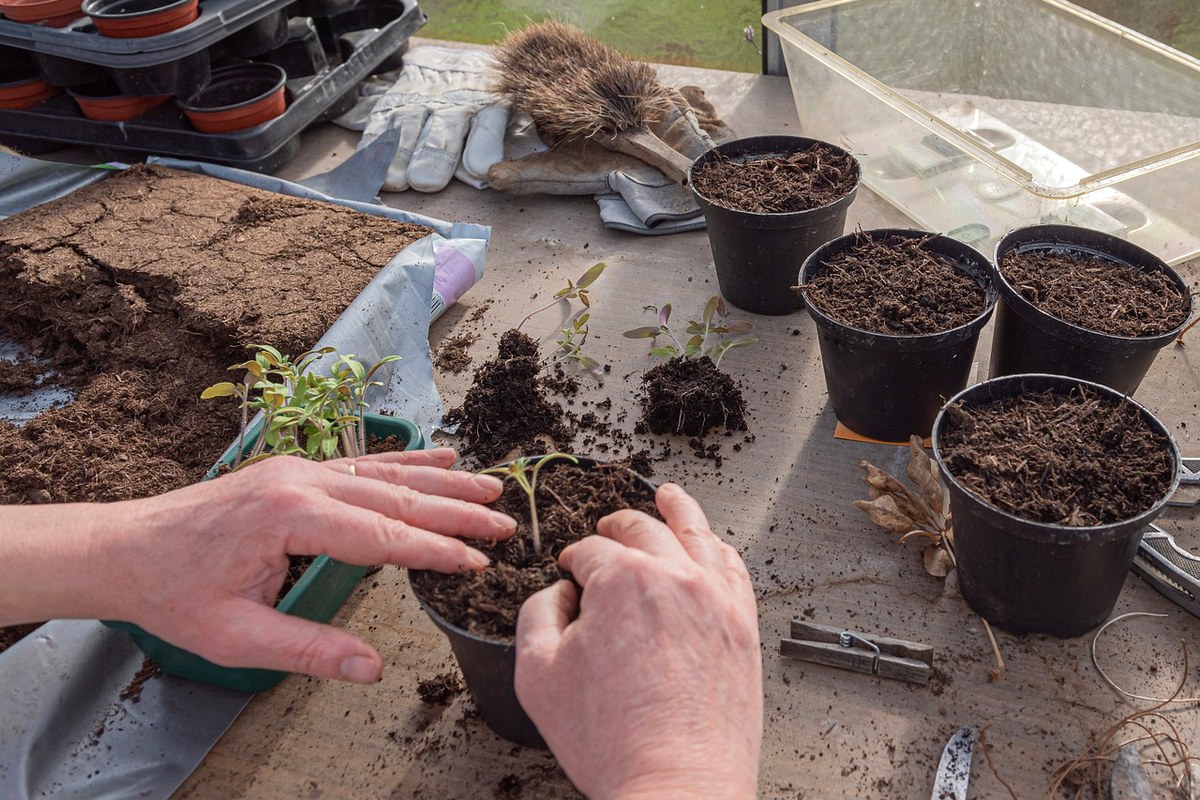
Harden off seedlings over about one to two weeks before planting, bringing them in if a freeze is forecast. Transplant on a cloudy day or late in the afternoon. A little wilting in the first day of full sun is normal, and most plants recover quickly.
Plan your spring from one date
When to start seeds indoors comes down to one number and some simple math. Find your frost date, count back from the weeks on each packet, and write the plan down. With a light, a few trays and some patience, you’ll have healthy plants ready right on time.
Start by entering your ZIP code in the calendar linked below. Then pull out your seed packets, mark each sowing week, and you’ll know exactly what to plant first.